
|
High Breakdown Voltage,
Fully Depleted Series |
Large Active Area Photodiodes |
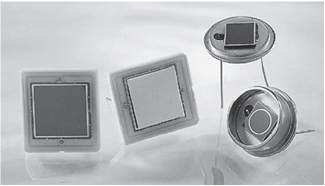 Using high-speed detectors with large areas, fully “depleted” junction zones can be created to achieve the lowest possible junction capacitance for fast rise times. They can be operated at higher reverse voltages, up to the maximum allowed value, to achieve even faster rise times in the nanosecond range. The high reverse bias enhances the effective electric field across the junction zone and increases the collection time in the “depleted” region. Please note that this is achieved without sacrificing high sensitivity or active area. Large-area radiation detectors can also measure high-energy X-rays, as well as high-energy particles such as electrons, alpha particles, and heavy ions. These types of radiation can be measured using two different methods: indirectly and directly.
Indirect high-energy radiation measurement
In this method, the detectors are coupled to a scintillator crystal to convert high-energy radiation into a detectable, visible wavelength. The detectors are mounted on ceramic and coated with a clear layer of epoxy resin to provide excellent optical coupling to the scintillator. This method is widely used for the detection of high-energy gamma rays and electrons. It is employed in cases where X-UV detectors can no longer measure energies above 17.6 keV. The type and size of the scintillator are selected depending on the type and magnitude of the radiation.
Direct high-energy radiation measurement
Both the PIN-RD100 and PIN-RD100A can also be used without epoxy resin or glass window for direct measurement of high-energy radiation, such as alpha particles and heavy ions. The radiation exhibits a linear energy loss along the penetration depth into the silicon after striking the active area.
The magnitude of the loss and the penetration depth are determined by the type and energy of the radiation. To measure the complete radiation, the “depletion layer” should be deep enough to cover the entire region from the point of incidence to the charge carrier collection point. Despite the large active area, the detectors feature ultra-low dark current, low capacitance, and low series resistance. In addition to their use in high-energy charge carrier detection, the PIN-RD100 and PIN-RD100A are an excellent choice for detection in the 350 to 1100 nm range for applications where a large active area and high speed are desired.
These detectors can be coupled to a charge-sensitive preamplifier or low-noise operational amplifier. The configuration for indirect measurement using a scintillator crystal is also shown.
Features
| High-Speed Photodetectors | Radiation detectors |
|
|
|
Applications
| High-Speed Photodetectors | Radiation detectors | |
|
|